
The Missile Man of India Class 8 Question Answer – UP Board Rainbow English Chapter 8
Introduction
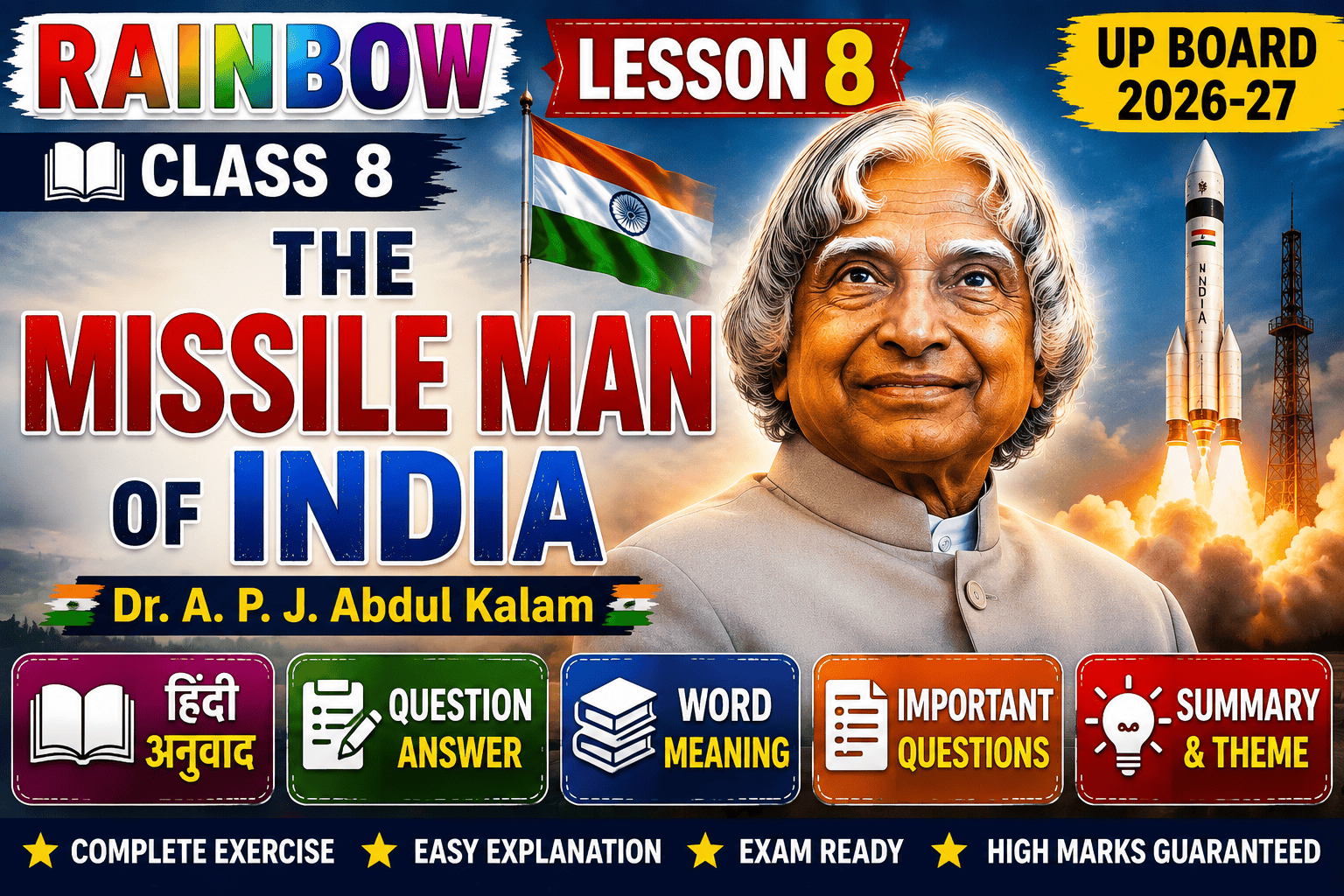
Rainbow Class 8 Lesson 8 – The Missile Man of India is an inspiring lesson based on the life of India’s former President and famous scientist Dr. A.P.J. Abdul Kalam. The chapter tells us about his childhood, education, scientific achievements, books, awards, and his dream of making India a developed nation. Because of his remarkable contribution to India’s missile programme, he is popularly known as the Missile Man of India.
missile man of india class 8 up board, rainbow class 8 chapter 8, class 8 english chapter 8 up board, the missile man of india hindi translation, apj abdul kalam class 8 chapter
भाग–1
English: Avul Pakir Jainulabdeen Abdul Kalam… newspapers to support his family.
हिंदी अनुवाद
अवुल पकिर जैनुलाब्दीन अब्दुल कलाम, जिन्हें सामान्यतः डॉ. ए.पी.जे. अब्दुल कलाम के नाम से जाना जाता है, भारत के 11वें राष्ट्रपति थे। उन्होंने वर्ष 2002 से 2007 तक राष्ट्रपति के रूप में देश की सेवा की। उनका जन्म 15 अक्टूबर 1931 को तमिलनाडु के रामेश्वरम में हुआ था। वे एक साधारण और गरीब परिवार में जन्मे थे, लेकिन बचपन से ही अत्यंत प्रतिभाशाली थे। उनके पिता जैनुलाब्दीन नाव चलाकर रामेश्वरम मंदिर आने वाले श्रद्धालुओं को नदी पार कराते थे तथा स्थानीय मस्जिद के इमाम भी थे। उनकी माता आशियम्मा एक गृहिणी थीं। परिवार की आर्थिक सहायता के लिए डॉ. कलाम ने बचपन में ही काम करना शुरू कर दिया। वे इमली के बीज और समाचार पत्र बेचकर अपने परिवार का सहयोग करते थे।
भाग–2
English: After completing his schooling… Madras Institute of Technology (MIT).
हिंदी अनुवाद
रामेश्वरम एलीमेंट्री स्कूल से प्रारम्भिक शिक्षा पूरी करने के बाद डॉ. कलाम ने सेंट जोसेफ कॉलेज, तिरुचिरापल्ली में प्रवेश लिया। यह कॉलेज मद्रास विश्वविद्यालय से संबद्ध था, जहाँ से उन्होंने वर्ष 1954 में भौतिक विज्ञान (Physics) में स्नातक की डिग्री प्राप्त की। इसके बाद उन्होंने मद्रास इंस्टीट्यूट ऑफ टेक्नोलॉजी (MIT) से एयरोनॉटिकल इंजीनियरिंग में विशेषज्ञता प्राप्त की।
भाग–3
English: Dr. Abdul Kalam was a great scientist… launch vehicle technology.
हिंदी अनुवाद
डॉ. अब्दुल कलाम एक महान वैज्ञानिक थे। उन्हें इंस्टीट्यूट ऑफ स्पेस साइंस एंड टेक्नोलॉजी का चांसलर बनाया गया। उन्होंने रक्षा अनुसंधान एवं विकास संगठन (DRDO) में वर्ष 1958 से कार्य किया और बाद में भारतीय अंतरिक्ष अनुसंधान संगठन (ISRO) से जुड़ गए। उन्होंने भारत के उपग्रह कार्यक्रम तथा मिसाइल कार्यक्रम में महत्वपूर्ण योगदान दिया। SLV-III परियोजना के निदेशक के रूप में उन्होंने भारत के पहले स्वदेशी उपग्रह प्रक्षेपण यान का सफल विकास किया, जिसने रोहिणी उपग्रह को पृथ्वी की कक्षा में स्थापित किया। उन्होंने अग्नि, पृथ्वी, आकाश, त्रिशूल और नाग जैसी मिसाइलों के विकास में महत्वपूर्ण भूमिका निभाई। इसी कारण उन्हें “भारत का मिसाइल मैन” कहा जाता है।
भाग–4
English: Besides being such a great scientist… thoughts result in action.
हिंदी अनुवाद
महान वैज्ञानिक होने के साथ-साथ डॉ. कलाम एक उत्कृष्ट लेखक भी थे। उन्होंने Wings of Fire, Ignited Minds, Target 3 Billion, Turning Point, India 2020: A Vision for the New Millennium तथा My Journey जैसी प्रसिद्ध पुस्तकें लिखीं। अपनी पुस्तक India 2020 में उन्होंने भारत को एक विकसित राष्ट्र बनाने का सपना व्यक्त किया। युवाओं के लिए उनका प्रसिद्ध संदेश था— “Dream, Dream, Dream. Dreams transform into thoughts and thoughts result in action.” अर्थात् सपने विचारों में बदलते हैं और विचार कार्यों में बदल जाते हैं।
भाग–5
English: The Government of India honoured him… If you want to shine like a sun, first burn like a sun.
हिंदी अनुवाद
भारत सरकार ने डॉ. कलाम को पद्म भूषण (1981), पद्म विभूषण (1990) और देश के सर्वोच्च नागरिक सम्मान भारत रत्न सहित अनेक पुरस्कारों से सम्मानित किया। उन्हें इंदिरा गांधी राष्ट्रीय एकता पुरस्कार (1997) भी प्राप्त हुआ। 27 जुलाई 2015 को शिलांग स्थित भारतीय प्रबंधन संस्थान (IIM) में व्याख्यान देते समय उनका निधन हो गया। उनकी अचानक मृत्यु से पूरा देश और विश्व शोकाकुल हो गया। डॉ. कलाम का जीवन सादगी, विनम्रता और देशभक्ति का अद्भुत उदाहरण है। उनका प्रसिद्ध प्रेरणादायक संदेश है— “If you want to shine like a sun, first burn like a sun.” अर्थात यदि सूर्य की तरह चमकना चाहते हो, तो पहले सूर्य की तरह तपना सीखो।
Word Meaning
| English | Hindi |
|---|---|
| Brilliant | प्रतिभाशाली |
| Pilgrims | तीर्थयात्री |
| Graduated | स्नातक किया |
| Specialised | विशेषज्ञता प्राप्त की |
| Scientist | वैज्ञानिक |
| Contribution | योगदान |
| Indigenous | स्वदेशी |
| Missile | मिसाइल |
| Chancellor | कुलाधिपति |
| Honour | सम्मान |
| Humble | विनम्र |
| Lecture | व्याख्यान |
| Developed | विकसित |
| Dream | सपना |
| Inspiration | प्रेरणा |
Comprehension Questions
the missile man of india class 8 question answer
(a) When and where was APJ Abdul Kalam born?
Answer: Dr. A.P.J. Abdul Kalam was born on 15 October 1931 at Rameshwaram, Tamil Nadu.
हिंदी उत्तर: डॉ. ए.पी.जे. अब्दुल कलाम का जन्म 15 अक्टूबर 1931 को रामेश्वरम, तमिलनाडु में हुआ था।
(b) What did he do to help his family?
Answer: He sold tamarind seeds and newspapers to support his family.
हिंदी उत्तर: उन्होंने अपने परिवार की सहायता के लिए इमली के बीज और समाचार पत्र बेचे।
(c) Name two research organisations where he worked.
Answer: DRDO and ISRO.
हिंदी उत्तर: डीआरडीओ (DRDO) और इसरो (ISRO)।
(d) Name the book in which he mentioned his dream of making India a developed country.
Answer: India 2020: A Vision for the New Millennium.
हिंदी उत्तर: India 2020: A Vision for the New Millennium।
(e) List the awards by which APJ Abdul Kalam was honoured.
Answer: Padma Bhushan, Padma Vibhushan, Bharat Ratna and Indira Gandhi Award for National Integration.
हिंदी उत्तर: पद्म भूषण, पद्म विभूषण, भारत रत्न तथा इंदिरा गांधी राष्ट्रीय एकता पुरस्कार।
(f) Why is Dr. Kalam known as the ‘Missile Man of India’?
Answer: Because he played a major role in developing India’s missile and launch vehicle technology.
हिंदी उत्तर: क्योंकि उन्होंने भारत के मिसाइल एवं प्रक्षेपण यान कार्यक्रम के विकास में महत्वपूर्ण योगदान दिया।
Word Power
1. Complete the names of the missiles
- Agni
- Prithvi
- Naag
- Akash
- Trishul
2. Fill in the blanks
- The principal of our school is a man of principles.
- Small children have little hands.
- You should live in unity because union is strength.
- The handsome young man has a beautiful wife.
Language Practice
1. Correct Degree of Adjectives
- Birbal was cleverer than the other ministers.
- Mount Everest is the highest peak in the world.
- China is a big country.
- Supriya is the tallest girl in the class.
- James is two years older than me.
2. Form Adverbs
- My grandmother prays silently.
- The sun was shining brightly.
- We must drive carefully.
- She writes very neatly.
- The soldier fought bravely.
3. Rewrite with Punctuation
a. Will you help me?
b. Delhi, the capital of India, stands on the banks of the River Yamuna.
c. How beautiful the sky is!
d. “Where do you want to go?” asked Meera.
Summary
Dr. A.P.J. Abdul Kalam was a great scientist, teacher, writer, and the 11th President of India. Despite growing up in a poor family, he achieved great success through hard work and determination. He made remarkable contributions to India’s space and missile programmes and inspired millions of young people to dream big and work hard.
Moral
- Dream big and work hard.
- Education is the key to success.
- Never give up because of difficulties.
- Serve the nation with honesty and dedication.
FAQs
Q1. Why is Dr. Kalam called the Missile Man of India?
Answer: Because he played a major role in developing India’s missile technology.
Q2. Which is the autobiography of Dr. Kalam?
Answer: Wings of Fire.
Q3. When did Dr. Kalam become the President of India?
Answer: In 2002.
Q4. What was Dr. Kalam’s famous quote?
Answer: “Dream, Dream, Dream. Dreams transform into thoughts and thoughts result in action.”
Q5. When did Dr. Kalam pass away?
Answer: On 27 July 2015.
Pingback: Rainbow Class 8th – Hamaraschool.com